


Let’s imagine the following scenario: a pianist and a trumpet player both have a C written on their sheet music. They play the note at the same time, but the notes they hear are different. While the piano sounds C, a B-flat trumpet actually sounds B-flat.
Confusing? At first, definitely. But there is a simple explanation: the trumpet is, in fact, what we call a transposing instrument.
In this guide, we will walk you through what transposing instruments are, how they work, why they exist, and how you can transpose sheet music more easily.
What Is a Transposing Instrument, and How Does It Work?
Let’s start with the foundation: what music transposition actually is. In music, transposition generally means moving notes or an entire piece to a different pitch or key while preserving the same musical and intervallic relationships.
A transposing instrument, however, works a little differently. It is a musical instrument for which the written pitch and concert pitch are not the same. In other words, the note a musician sees on the sheet music is not necessarily the note you actually hear the instrument produce. Instead, the instrument sounds at a fixed interval above or below the written pitch. Here, written pitch refers to the note shown on the page, while concert pitch refers to the pitch that is actually heard.
Let’s make this clearer with an example: When a pianist sees a written C and plays it, the note you hear is also C. But when a musician playing a B-flat clarinet or B-flat trumpet reads and plays a written C, the note you actually hear is B-flat instead – not C.
The same applies to other transposing instruments, too. On an E-flat alto saxophone, for example, a written C sounds as E-flat, a major sixth lower. Meanwhile, on a French horn in F, a written C sounds as F, a perfect fifth lower.
The transposing instrument’s name then typically comes from the pitch that sounds when the player reads a written C. For example, when a B-flat clarinet or B-flat trumpet plays a written C, the sounding – or concert – pitch is B-flat, which is why they are called B-flat instruments. Similarly, on a clarinet in A, a written C sounds as concert A, while on an alto flute in G, it sounds as concert G.
Importantly, the transposing relationship doesn’t apply only to written C. A transposing instrument sounds at the same fixed interval above or below every written note. For example, a B-flat trumpet sounds a major second lower than written: a written C sounds as B-flat, a written D sounds as C, a written E as D, a written F as E-flat, and so on.
This fixed relationship is built into the way the instrument’s music is notated. In other words, the instrument doesn’t change as it is played; instead, the music is written at a fixed transposition relative to concert pitch. As a result, the transposition remains consistent across every note: the relationships between the notes stay the same, while the entire melody simply sounds at a different pitch level.
Why Do Transposing Instruments Exist?
There are two main reasons why transposing instruments and transposed notation exist:
1. To Make Playing and Reading Easier
Some instrument families include instruments in different sizes and ranges, with larger versions generally producing lower pitches than the smaller ones. Common examples include clarinets, flutes, saxophones, and trumpets.
Using transposed notation allows the same written notes to correspond to the same or very similar fingering patterns across instruments within a family, even though the pitches they actually produce differ.
The saxophone family is a good example. Thanks to transposed notation, a musician switching between alto, tenor, and baritone saxophones can read the same written notes and use the same basic fingerings for them, while each instrument produces pitches in a different range. This makes it significantly easier for musicians to move between related instruments without having to learn an entirely new system of note-to-fingering relationships each time.
Transposed notation can also make sheet music easier to read. Octave-transposing instruments such as the piccolo, guitar, and double bass are written an octave away from their actual sounding pitch, helping to avoid too many notes being written far above or below the staff.
2. Historical Tradition
Before valves became common in the 19th century, some brass instruments like horns and trumpets could naturally produce only notes belonging to the harmonic series of a particular fundamental pitch. For example, an instrument pitched in C could produce notes from the C harmonic series, rather than freely playing every note of the chromatic scale.
To make it possible for these instruments to play in different keys, musicians used crooks – interchangeable sections of tubing that could change the instrument’s length and, in turn, its fundamental pitch. Different crooks allowed the same horn to be used in different keys, but changing them could be time-consuming and inconvenient for players.
Because musicians could use the same instrument with different crooks, the written notation could remain based on the same familiar note patterns while the actual sounding pitch changed depending on which crook was attached. In other words, players could read the part in the same way even when the instrument was pitched in a different key. This historical system helped establish the tradition of writing horn and other brass parts as transposing parts, even after valves made playing chromatically and in different keys much easier.
Common Types of Transposing Instruments
We’ve already mentioned a few examples, but transposing instruments can be grouped according to the pitch that sounds when they play a written C. Let’s take a closer look at some of the most common groups.
B-flat Instruments (B♭)
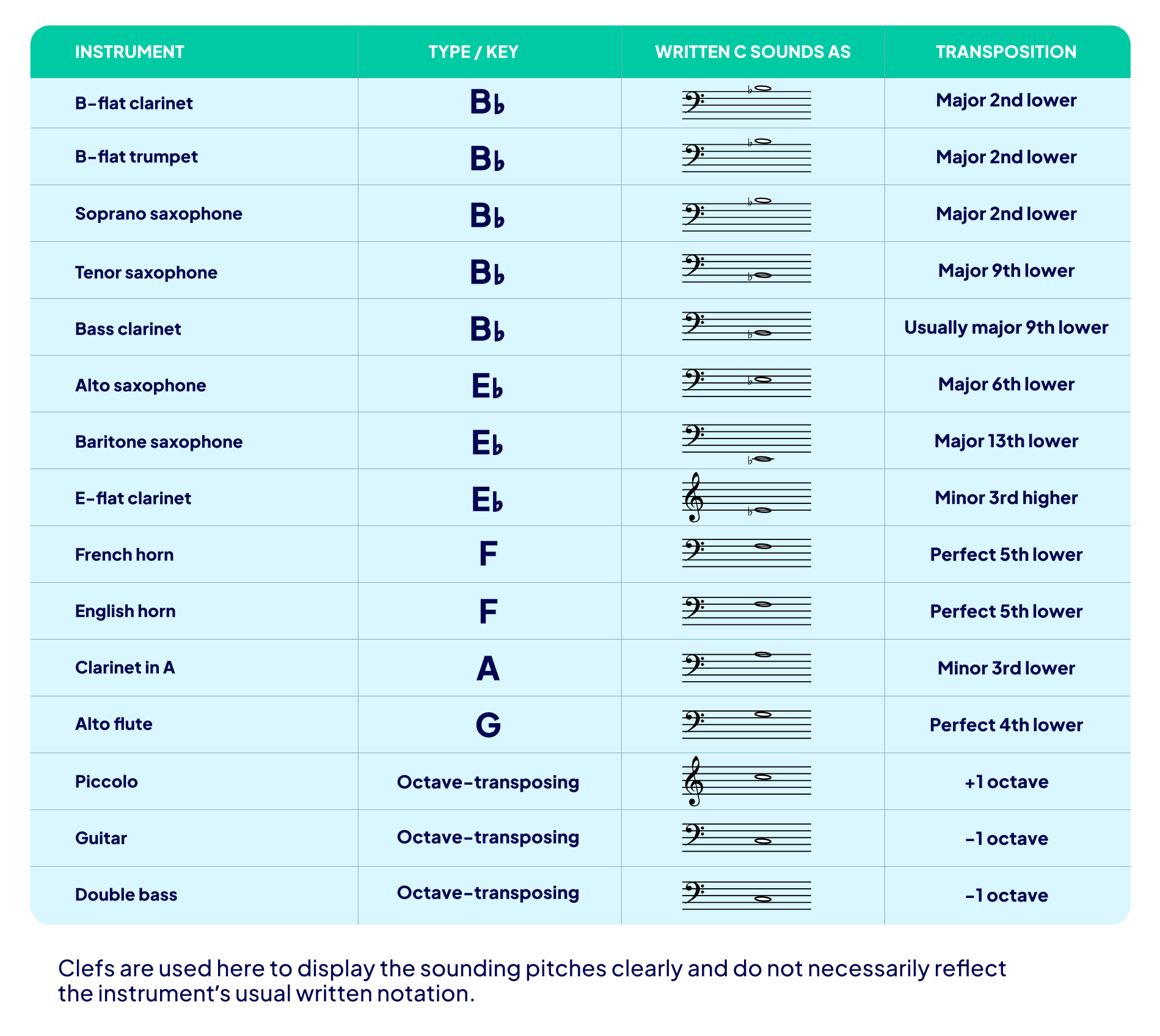
B-flat instruments include the B-flat clarinet, B-flat trumpet, and soprano saxophone. When these instruments play a written C, the sounding pitch is B♭, a major 2nd lower.
Notably, the tenor saxophone is also a B-flat instrument, but it sounds an octave lower than the instruments above. A written C therefore sounds as B♭, a major 9th lower. Similarly, the bass clarinet in B-flat typically sounds a major ninth below its written pitch when its part is written in treble clef.
E-flat Instruments (E♭)
Common E-flat instruments include the alto saxophone, baritone saxophone, and E-flat clarinet. When they play a written C, the sounding note is E♭, although the transposition interval differs between instruments.
On the alto saxophone, a written C sounds a major 6th lower; on the baritone saxophone, it sounds a major 13th lower. The E-flat clarinet, meanwhile, sounds a minor 3rd higher than written.
F Instruments
F instruments are fairly straightforward. Common examples include the French horn and the English horn, also known as the cor anglais. On both instruments, a written C sounds as F, a perfect 5th lower.
A Instruments
The main example of an A instrument is the clarinet in A. On this instrument, a written C sounds as A, a minor third lower.
Octave-Transposing Instruments
Octave-transposing instruments are a unique group because, unlike the instruments above, they transpose by one or more full octaves. What this means is that they do not change the letter name of the sounding note; instead, they only change the pitch by a full octave – or even two in the case of the glockenspiel – higher or lower.
So, when a musician plays a written C on an octave-transposing instrument, the sound that comes out is still a C – it just sounds higher or lower than where it is written on the page.
Common examples include the piccolo, which sounds one octave higher than written, and the guitar and double bass, which sound one octave lower. The reason for this notation is mainly practical: it keeps notes closer to the staff and makes the sheet music easier to read.
Transposing Instruments Chart
Notation in the “Written C sounds as” column shows the sounding pitch. Clefs are chosen for readability and do not necessarily reflect the instrument’s usual written notation.
Which Instruments Do Not Transpose?
There is – as one might say – an opposite group to transposing instruments: non-transposing instruments, or more commonly known as concert pitch instruments.
Their description is perfectly straightforward: what you see is essentially what you hear. In other words, the written note and the sounding note are the same. There are no shifted note names or octave jumps. If a player reads and plays a written C, the note you hear is also C – and a digital tuner will display C as well.
Many common orchestral and band instruments fall into this category. These include:
1. Keyboard instruments, such as piano, organ, and harpsichord
2. String instruments, such as violin, viola, and cello – BUT remember that double bass is an octave-transposing instrument
3. Woodwinds, including flute, oboe, and bassoon
4. Trombone, which is typically written at concert pitch in orchestral music despite being a brass instrument.
5. Tuned percussion, such as timpani and marimba
How to Transpose for a Transposing Instrument
An important part of working with transposing instruments is knowing how to transpose music for them. The process essentially bridges the gap between concert pitch (what the audience or a non-transposing instrument such as the piano hears) and written pitch (what the player sees on the page).
The process depends entirely on whether you are writing a part for a player or converting a player’s part back to concert pitch. Here’s a simple three-step formula:
1. Find the Instrument’s Transposition Interval
As we know from before, every transposing instrument has a specific transposition interval. The golden rule is: a transposing instrument’s name tells you what concert pitch sounds when the player reads a written C.
For example, on a B-flat trumpet, a written C sounds as concert B-flat. This means the instrument sounds a major second lower than written.
However, the instrument’s name alone does not always tell you the full transposition interval, as some instruments also sound in a different octave. The tenor saxophone, for example, is also a B-flat instrument, but it sounds a major ninth lower than written. To find the correct interval, you can check a transposition chart or an instrument-specific guide.
2. Choose Your Direction
Once you know the interval by which an instrument transposes, determine which direction you are going: from written pitch to concert pitch, or from concert pitch to written pitch.
If you’re converting written pitch to concert pitch, move each note by the instrument’s sounding interval. For a B-flat trumpet, this means moving every note down one whole step. A written C becomes concert B-flat, written D becomes C, and so on.
If you’re working in the opposite direction – from concert pitch to the part the musician needs to read – you reverse the interval. For the same B-flat trumpet, you move each note up by one whole step. Concert C therefore becomes written D, concert D becomes written E, and so on.
The same principle applies to every transposing instrument, although the interval will differ depending on the instrument.
3. Change the Key Signature
Finally, you also need to transpose the key signature, not only the individual notes. For example, if a piece is in concert C major and you are writing it for a B-flat trumpet, the written part will be in D major. This makes sure that the entire piece – not just individual notes – is shifted by the correct interval.
How to Transpose Music More Easily?
As we’ve just seen, transposing music manually is perfectly possible. However, once you’re working with an entire piece rather than just a few notes, the process can quickly become time-consuming. You need to shift every note as well as the key signature by the correct interval and account for accidentals too.
This is where digital sheet music tools can make things significantly easier. With a platform like Halbestunde, you can scan or upload your sheet music, turn it into an interactive score, and transpose the entire piece to a different key without having to rewrite every note manually.
This can be particularly useful when you need to move a piece into a different key, rewrite for a transposing instrument, adapt it to a different range, or simply want to find a key that better suits a particular player or singer. Instead of calculating and rewriting the entire piece yourself, you can simply change the key digitally and continue working with the transposed score directly.
One thing to remember, though, is that transposing an entire piece into another key and preparing a correctly notated part for a transposing instrument are not always exactly the same thing. If you’re writing specifically for an instrument such as an alto saxophone or French horn, you still need to know the instrument’s required transposition and choose the appropriate target key.
Conclusion
Transposing instruments may seem confusing at first, but the principle behind them is actually fairly straightforward: the note written on the page and the note you hear are separated by a fixed interval.
Once you know an instrument’s transposition interval and understand the difference between written and concert pitch, reading, writing, and transposing music for different instruments becomes significantly easier.
FAQs
What is a transposing instrument?
A transposing instrument is a musical instrument for which the written pitch and the sounding, or concert, pitch are different. The instrument sounds at a fixed interval above or below the note written on the page.
How do you identify an instrument's transposition interval?
First, determine what concert pitch sounds when the musician plays a written C. For example, a written C on a B-flat trumpet sounds as concert B-flat. You also need to account for any octave displacement, as instruments with the same key can transpose by different intervals.
What are octave-transposing instruments?
Octave-transposing instruments alter the sounding pitch by one or more full octaves without changing the letter name of the note. Instruments like the guitar and double bass sound one octave lower than written, while the piccolo sounds one octave higher, primarily to avoid using excessive ledger lines.
What is the difference between concert pitch and written pitch?
Concert pitch is the actual sounding pitch heard by the audience or played by a non-transposing instrument like the piano. Written pitch is the note printed on the sheet music for the performer to read.
How do you transpose written music to concert pitch?
To convert a transposing instrument's written part to concert pitch, shift every note and the key signature by the instrument's specific transposition interval. For a B-flat trumpet, for example, this means moving the music down by one whole step, or a major second.
